Working hours:Mon - Sat 8.00 - 18.00 Call Us: + 91 (22) 4969 4419 / + 91 (22) 3510 0200
Plastic Collated Nails
Plastic Collated Nails: These nails held together with plastic strip resistant to any weather conditions. They are most commonly used for outdoor work such as siding, subfloors, and roof sheathing. During nailing, the nails are easily detached from the plastic strip connecting them, so the direction of nailing remains unchanged. Working with such nails becomes much simpler and cleaner because there are no extra scraps of plastic left.
Product Description
Size (Commonly used) | Packing | |
2-3/8″ x .113 | Type of Collating | Loose Nails |
3″ x .131 | No. of Pec (per Box) | 4000 to 5000 |
3″ x .120 | No. of nail (Per Strip) | 25 to 30 |
3-1/4″ x .131 | No. of Strips (Per Box) | 140 to 200 |
2-3/8″ x .113 | Net weight in Kgs (Per Box) | 15 to 23 kgs |
2-3/8″ x .113 | No. of Boxes (per Pallete) | 36 to 48 Boxes |
3″ x .120 | ||
NOTE:
• Customization in nail sizes, point, top and shank modifications are available upon request.
• The above said nails confirms to ASTM F1667 Std.
• Above mention packaging details are standard and will vary as per sizes.
• Customized packaging details available on request.
• Nails are packed in labeled carton boxes with our name and logo. Plain carton boxes can be made available on request.
• Customized printing, selected logo, text, other graphic option available.
• Having been located at multiple location with warehousing facilities DOOR TO DOOR DELIVERY option is available at our end.
• The above said nails confirms to ASTM F1667 Std.
• Above mention packaging details are standard and will vary as per sizes.
• Customized packaging details available on request.
• Nails are packed in labeled carton boxes with our name and logo. Plain carton boxes can be made available on request.
• Customized printing, selected logo, text, other graphic option available.
• Having been located at multiple location with warehousing facilities DOOR TO DOOR DELIVERY option is available at our end.
Heads types:
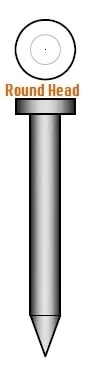 Full Round
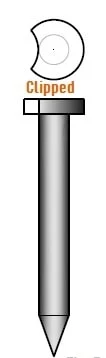 Clipped
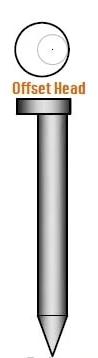 Offset
Nail shank types:
 Smmoth
 Ring
Ring Screw
Screw
Nail Cutting Point types:
 Diamond
 Clinch
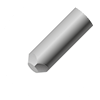 Blunt
Blunt
Nail finishing types:
 vinyl coated
 White
White Yellow
 Bright
FIND AN ANSWER
FAQ’s?
- Where are plastic strip nails used?
- What are the different head types?
- What are the different shank types?
- What are the different point types?
- What are the different finishing types?
Where are plastic strip nails used?
Plastic strip nails are commonly used in framing, sheathing, carpentry, and in other wood applications where strong holding power is required.
What are the different head types?
- Round head – These are the standard nails with full round shaped head which we often see & use.
- D head / Clipped Head – These are nails with a portion of their round head clipped. While people often call them as D shaped nails, the head of the clipped nails cover more than a semi-circle.
- Offset – This nail has a full round head, which is offset from the center of the nail axis.
What are the different shank types?
- A smooth shank allows to enter the material more easily.
- Ring shank nails have very high initial withdrawal resistance. Therefore, they are used in many wood framing and sheathing applications.
- Screw shank nails twist and rotate as it is driven into the wood.
What are the different point types?
- Diamond point is the most common nail tip giving the best possible penetration into the material.
- Clinch point nails are used to secure boards of pallets and other wooden structures. They bend easily under the metal base.
- Blunt point nails prevent the wood from splitting when driven as It breaks through the wood.
What are the different finishing types?
- Bright nails are not coated with a protective finish layer which means they are more vulnerable to outdoor conditions.
- Vinyl coated nails use a slick vinyl coating for easier nail driving into the material. However, this coating does not protect the nail from corrosion.
- Electro-galvanized (white / yellow) nails have a zinc coating on surface which offers corrosion protection. They are generally used in areas where minimal corrosion protection is needed.
CONTACT US & LEARN MORE ABOUT US
Looking for a reliable & stable partner?

Mumbai
Head Office
201, Keshava, Bandra Kurla Complex,
Bandra (E), Mumbai 400051 India.
Bandra (E), Mumbai 400051 India.
LOCATIONS